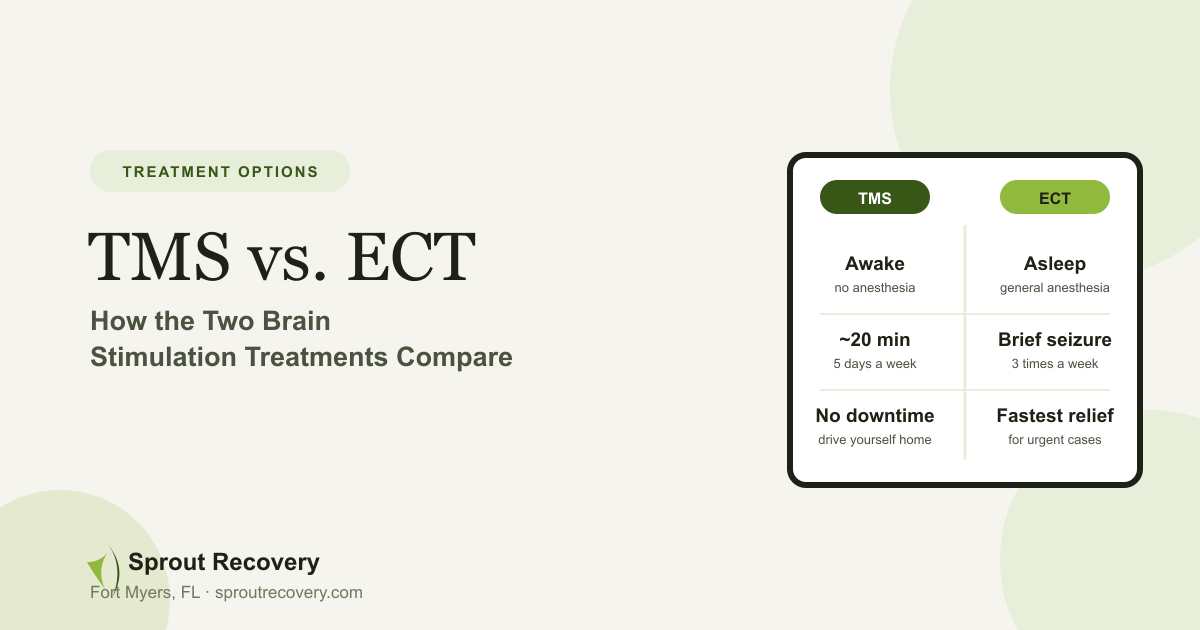
Transcranial magnetic stimulation (TMS) uses magnetic pulses while you are awake, with no anesthesia. Electroconvulsive therapy (ECT) uses a brief, controlled seizure while you are under general anesthesia. Both treat depression that has not improved with other care, but they differ in who they fit, how recovery feels, and how you qualify.
This guide compares the two side by side, including side effects and treatment schedules. While Sprout Recovery does not offer ECT, we offer TMS therapy in Fort Myers.
How ECT and TMS Work
Before ECT, you receive a short-acting general anesthetic and a muscle relaxant through an IV. Once you’re asleep, the care team places electrodes on your head and sends a small, carefully controlled electrical current to the brain. This triggers a brief, controlled seizure in the brain that lasts less than a minute. Because of the anesthesia, you do not feel pain or the electrical pulses. A medical team that includes an anesthesiologist monitors your breathing, heart rate, and blood pressure.1
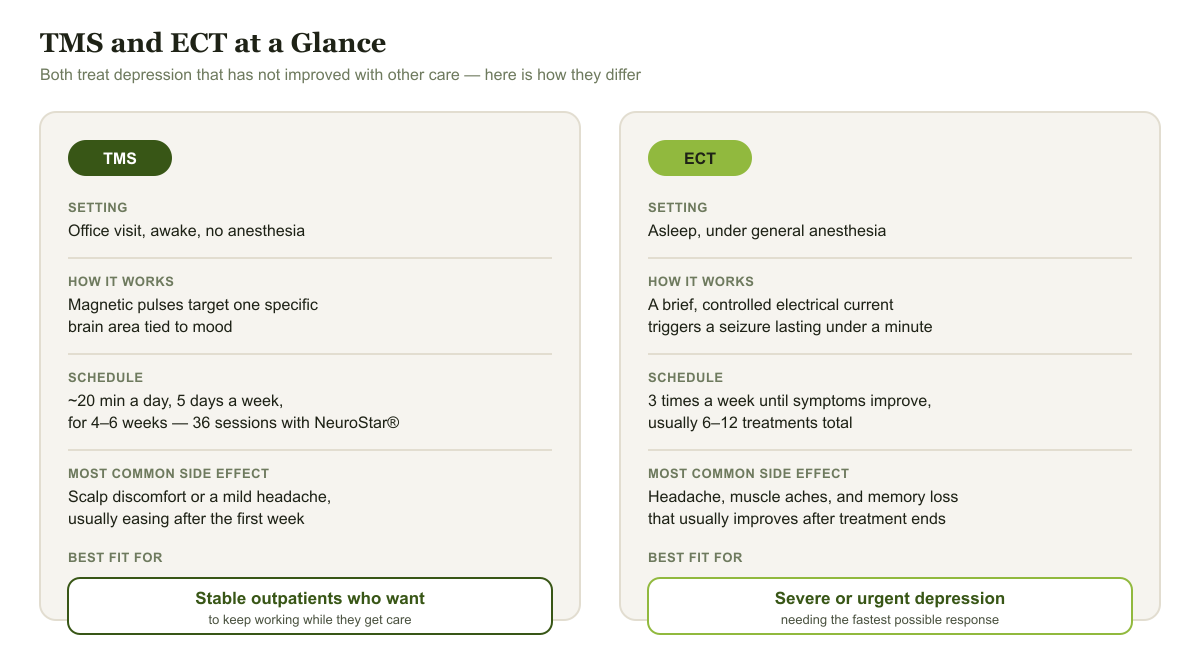
TMS works differently. An electromagnetic coil rests against your head near an area of the brain involved in mood. It sends repeated magnetic pulses, about the same strength as an MRI scanner, which creates small electrical pulses in the nerve cells underneath. ECT stimulates the brain more broadly, while TMS targets one specific site, and TMS can be done in an office without anesthesia.1
At Sprout Recovery, TMS is delivered with the NeuroStar® system. NeuroStar® is FDA-cleared for adults with major depression who have not improved enough with antidepressant medication in their current episode.2
Who Each Treatment Is For
ECT is usually considered after other treatments have not helped. People who qualify generally have severe, treatment-resistant depression, or they need a fast response because of a life-threatening situation, such as being unable to move or respond, being suicidal, or not eating enough.1 ECT also starts working faster than antidepressant medication, usually within the first week.
ECT may also be an option when medications have not worked, cause side effects that cannot be tolerated, or are unsafe because of another physical illness. The National Institute of Mental Health notes that this is often the case for older adults.1
TMS is designed for adults with major depression who have tried medication without enough relief. It has not been evaluated for people with psychosis or for psychiatric emergencies that need a rapid response, such as catatonia or an immediate risk of suicide, and it is not recommended in those situations.1
ECT is still considered the gold standard for treatment-resistant depression, and TMS does not match its effects. Even so, strong clinical evidence supports TMS for reducing depression symptoms. In practice, ECT tends to be used for the most severe or urgent cases, while TMS fits people who are stable enough for outpatient care and want to keep up with work and family life.
Treatment Schedule and Recovery Time
A typical ECT course is given three times a week until symptoms improve, usually within 6 to 12 treatments.1 You wake up 5 to 10 minutes after the procedure. You may feel groggy at first, but most people are alert after about an hour.
ECT usually needs follow-up care to keep the improvement going. That can mean antidepressant medication, maintenance ECT, or both. Maintenance sessions range from once a week to once every few months, depending on the person.1
TMS is usually given in daily sessions, five days a week, for four to six weeks.1 A typical NeuroStar® course is 36 sessions over about six weeks.2 At Sprout Recovery, each session takes about 20 minutes. There is no recovery period, so most people drive themselves home and go back to their day.
For many adults, this is the biggest practical difference. TMS can fit around a work schedule. ECT involves anesthesia on every treatment day, so it takes more planning around work, rides, and family responsibilities.
Side Effects: Is TMS Safe?
Overall, TMS is considered safe and well tolerated. Possible side effects include discomfort where the coil touches your head, tingling or twitching in the scalp, jaw, or face muscles during treatment, mild headaches, and brief lightheadedness. With NeuroStar®, the most common side effects are scalp pain and headache, which are usually mild to moderate. For most people, discomfort at the treatment site stops after the first week.2
The most serious risk is a seizure, and it is rare. NeuroStar® estimates the risk at about 1 in 1,000 patients, or 1 in 30,000 treatments.2 The risk is higher for people with a personal or family history of seizures, a past stroke or head injury, or medications that lower the seizure threshold.2 Long-term side effects of TMS have not been fully studied.
ECT has a different side effect profile. The most common effects are headaches, upset stomach, muscle aches, memory loss, and confusion.1 Memory loss usually affects events around the time of treatment and tends to improve over the days and weeks after a course ends. Placing electrodes on one side of the head and using very short electrical pulses both lower the risk of memory problems.1 If ECT is recommended, ask your doctor about both.
Is TMS Safe With a Pacemaker?
A pacemaker does not automatically rule out TMS, but it calls for a careful review first. NeuroStar® labeling says TMS should be used with caution in people with implanted devices controlled by the body’s own signals, including pacemakers and implantable defibrillators. That caution applies even when the device is far from the coil because of the heart condition behind it.2
Some implants do rule TMS out. Metal in or near the head, such as cochlear implants, aneurysm clips, stents, and brain stimulators, is not compatible with treatment.2 Standard dental fillings are generally acceptable.2 Sprout Recovery screens for pacemakers, implants, and seizure history before TMS, so bring your device information and your cardiologist’s contact details to your free consultation.
“TMS treats depression, not the substance use itself. It is a separate outpatient service that can run on its own or alongside that care.”
What These Treatments Mean if You Also Use Substances
Depression and substance use often show up together. In 2025, 18.5 million adults in the U.S. had both a mental illness and a substance use disorder.4 About two in five adults with a substance use disorder also had a mental illness.4
If you drink heavily or use drugs, tell the TMS team. Alcohol withdrawal can cause seizures, and repeated withdrawal episodes can make later ones more severe, including the risk of seizures.5 Because TMS carries a small seizure risk, your screening will ask about recent drinking, withdrawal, and any drugs or medications that lower the seizure threshold. Honest answers help your psychiatrist decide whether TMS is safe and when to start.
TMS treats depression, not the substance use itself. At Sprout Recovery, substance use is treated through therapy and day programming alongside mental health care. TMS is a separate outpatient service that can run on its own or alongside that care. If you need medical withdrawal care first, our team can point you to a trusted provider.
How Eligibility and Coverage Work
Both treatments usually come after other options. For TMS, eligibility often means you have tried several antidepressants without enough relief, or you could not stay on them because of side effects. Each insurance plan sets its own rules. Our TMS candidacy quiz is a quick first check.
Does Medicare Cover TMS?
Yes, when certain criteria are met. In Florida, Medicare’s regional contractor considers TMS medically necessary for up to six weeks when three things are true: you have a confirmed diagnosis of severe major depression, you have not improved after one or more medication trials or cannot tolerate psychiatric medication, and a psychiatrist who examined you in person and reviewed your record writes the order.3
At Sprout Recovery, Medicare covers TMS. Coverage under commercial plans varies, so our admissions team checks your specific benefits before you commit to anything. If you are on Medicare and medication has not helped, TMS is worth asking about.
Is There a Waitlist for TMS?
The timeline usually depends more on paperwork than on a list. Getting started at Sprout Recovery begins with a free consultation, which takes 45 to 60 minutes and is never billed. Screening and a benefits check follow. For Medicare, a psychiatrist must examine you and write the order before treatment begins. Some commercial plans also require approval before the first session, which can add time. Call our admissions team to ask about current scheduling.
Questions to Ask Your Psychiatrist
The right choice depends on your symptoms, your medical history, and how quickly you need relief. These questions can help guide the conversation:
- How severe are my symptoms right now, and do I need a fast response?
- Which medications have I tried, at what doses, and for how long?
- Do I have a pacemaker, metal implants, or a history of seizures?
- What does my insurance or Medicare require before treatment starts?
- How will each option fit around my work, family, and transportation?
- TMS uses magnetic pulses while you are awake, with no anesthesia. ECT uses a brief, controlled seizure under general anesthesia.
- ECT works faster and is used for severe or urgent depression, while TMS fits people who are stable enough for outpatient care.
- TMS runs about five days a week for four to six weeks, and most people drive themselves home after each session.
- TMS side effects are usually mild, and the seizure risk is rare. ECT can cause short-term memory loss that usually improves after treatment ends.
- Pacemakers call for caution with TMS, and metal implants in or near the head rule it out.
- Medicare covers TMS when the criteria are met, including a psychiatrist’s order.
TMS Therapy in Fort Myers, FL
At Sprout Recovery, TMS is a standalone outpatient service for adults 18 and older, delivered with NeuroStar®. Sessions take about 20 minutes, five days a week, with no anesthesia and no downtime. TMS can run on its own or alongside medication management and therapy, whether you are dealing with depression, substance use, or both.
We verify commercial benefits before you commit to anything. For clients over 65, Medicare also covers TMS at Sprout Recovery. Book a free consultation, and our team will review what you have already tried and whether TMS fits.
Curious how TMS works for other conditions? See our guides to TMS for depression and TMS for anxiety.
- National Institute of Mental Health — Brain Stimulation Therapies (2024)
- Neuronetics — Important Safety Information About NeuroStar® (2026)
- First Coast Service Options — How to Bill Correctly for Transcranial Magnetic Stimulation (TMS) in the Treatment of Adults With Major Depressive Disorder (2026)
- Substance Abuse and Mental Health Services Administration — Key Substance Use and Mental Health Indicators in the United States: 2025 National Survey on Drug Use and Health (NSDUH Series H-61, HHS Publication No. PEP26-07-010)
- Canver, B. and Newman, R. — Alcohol Withdrawal Syndrome, StatPearls (2024)
This article is for general information and is not medical advice. Talk with a licensed provider about your own situation. If you are in crisis, call or text 988, or call 911 in an emergency.