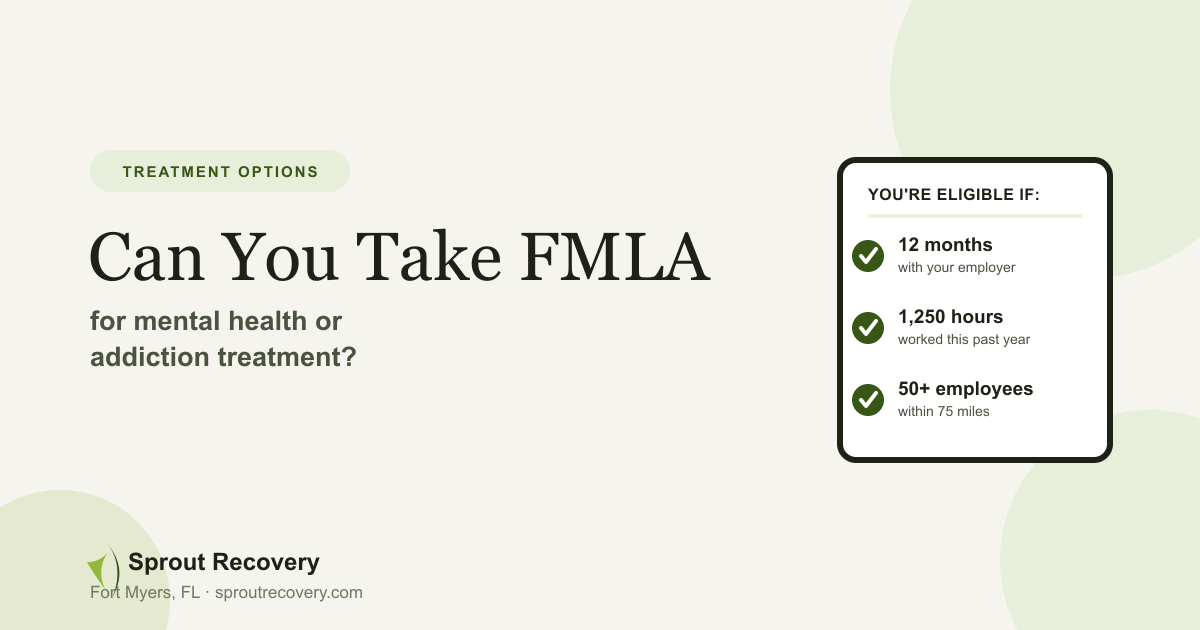
The short answer is yes. The Family and Medical Leave Act (FMLA) covers treatment for a serious health condition, including mental health conditions and substance use. You are eligible if you have worked for an FMLA-covered employer for 12 months, logged 1,250 hours in the past year, and work at a location with 50 employees within 75 miles.
FMLA-covered employers include private companies plus public agencies and schools of any size. If you meet the eligibility requirements, the law gives you time for mental health and substance use treatment without losing your job.
What FMLA Leave Protects
Eligible employees can take up to 12 workweeks of leave each year. During that time, the employer must keep your standard health insurance going on the same terms. When you come back, you return to the same job or one that is virtually identical.
FMLA leave can be unpaid, or it can be taken as paid vacation or sick leave using the time allowance your company provides.
What Counts as a Serious Health Condition
FMLA covers serious health conditions. A mental or physical health condition counts if it requires one of two things: an overnight stay in a hospital or treatment facility, or continuing treatment by a health care provider.
Continuing treatment covers two common situations:
- A condition that keeps you from working for more than three days in a row and needs ongoing care, such as several clinical appointments or a visit followed by medication or therapy.
- A chronic condition that flares up from time to time and needs treatment at least twice a year.
Does FMLA Cover Anxiety?
It can. The Department of Labor lists anxiety, depression, and dissociative disorders as examples of chronic conditions that may qualify.
One Department of Labor example describes a worker with severe anxiety who sees a doctor monthly. She uses FMLA leave on days her symptoms keep her from working, and for appointments scheduled during her shift. Leave does not have to be one long stretch.
FMLA for Rehab and Substance Use Treatment
Substance use can be a serious health condition under the same rules. The leave must be for treatment, either from a health care provider or from a program you were referred to by a healthcare provider. Time off because of the substance use itself, such as missing work to drink alcohol, does not count.
Can You Get Fired for Going to Rehab?
Your employer may not take action against you because you used FMLA leave for treatment. There is one important exception. If your employer already has a substance use policy that it applies equally and has shared with all employees, it may still fire you under that policy, even while you are on FMLA leave.
A second law, the Americans with Disabilities Act (ADA), adds protection. It covers people who are in a supervised rehab program, or who have completed one, and are no longer using illegal drugs. The ADA does not protect you if you are currently using illegal drugs. An employer can also hold every worker, including a person with alcohol use disorder, to the same job performance standards.
For mental health conditions, it is illegal for an employer to fire you simply because you have a condition. Employers do not have to excuse poor job performance, so the Equal Employment Opportunity Commission (EEOC), the federal agency that enforces the ADA, advises asking for changes at work before a mental health condition severely affects your performance and you risk losing your job.
These rules depend on your employer, your job, and your state. This article is general information, not legal advice. For a question about your situation, talk with HR or an employment attorney.
How to Get FMLA for Mental Health
The process is mostly paperwork. It usually follows these steps:
- Check your eligibility using the 12-month, 1,250-hour, and 50-employee rules above.
- Tell your employer you need leave for a health condition, and ask HR for its FMLA forms.
- Have your health care provider complete a medical certification. You generally have at least 15 calendar days to return it.
- If you need time off in blocks, the certification can estimate how often you will be away and for how long.
You do not have to share your diagnosis. The provider may include one but is not required to. Your employer must keep these records confidential and separate from your regular personnel file. Your direct supervisor may never contact your health care provider.
“You do not have to share your diagnosis. The provider may include one, but is not required to.”
Is There Help for Leave Paperwork?
Yes. If you need a letter for leave or reduced hours, the Sprout Recovery team helps with the documentation your employer may ask for. Whether you tell your employer anything about your treatment is your decision.
Full Leave, Reduced Hours, or Time Off in Blocks
FMLA leave can be broken into blocks rather than used all at once, which suits people who have regular appointments or are attending an outpatient program. A reduced leave schedule means working fewer hours per day or per week for a period of time, usually moving from full-time to part-time.
For either option, there must be a medical need to take leave. The certification from your provider explains that need.
The ADA offers another route. A reasonable accommodation is a change in how things are normally done at work, such as scheduling work around therapy appointments. If you cannot do your job even with an accommodation and have no paid leave left, unpaid leave may itself count as an accommodation.
How PHP Fits a Leave of Absence
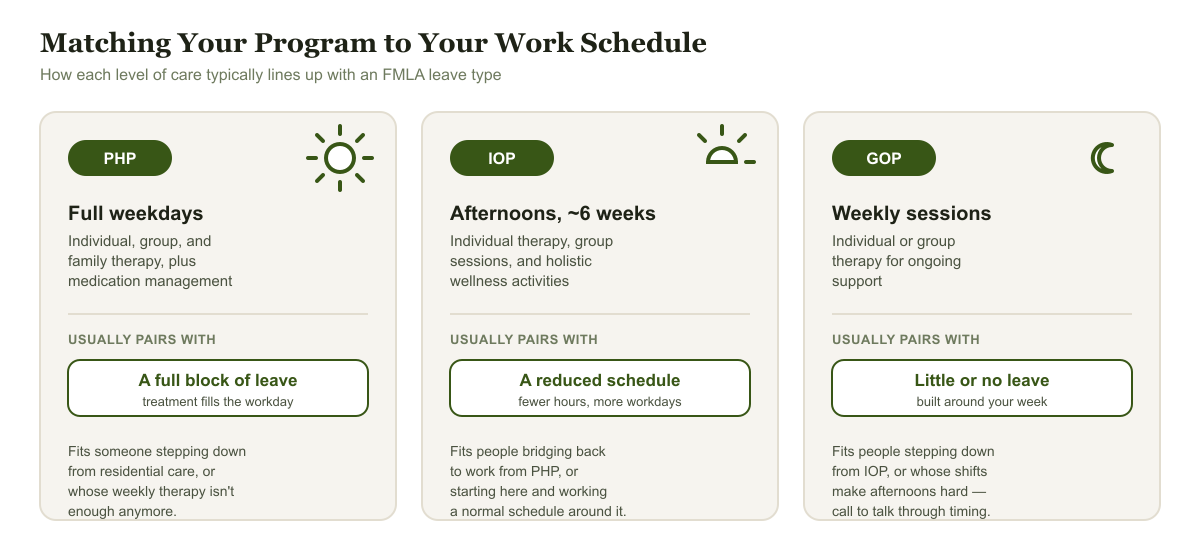
A Partial Hospitalization Program (PHP) is a structured kind of outpatient care. You attend treatment for most of the day and sleep at home. At Sprout Recovery, PHP runs on a full-day weekday schedule that includes individual therapy, group therapy, family therapy, and medication management.
Because PHP fills the workday, most people take a block of continuous leave while they attend. PHP fits people who need more than a few hours of care a week — someone stepping down from a residential stay, or someone whose weekly therapy is no longer enough.
How IOP Helps You Get Back to Work
An Intensive Outpatient Program (IOP) meets several times a week for a few hours at a time. It is the level of addiction and mental health care that follows PHP. At Sprout Recovery, IOP sessions run in the afternoons so people can keep working or attending school, and the program typically lasts about six weeks. Each week combines individual therapy, group sessions, and holistic wellness activities.
Many people use IOP as a bridge. They take full leave during PHP, then move to IOP and return to work on a reduced schedule. Others start in IOP and use intermittent leave or an adjusted work schedule for treatment — an arrangement that fits working professionals trying to stay in their role while they get care.
Can I Keep Working During Treatment?
In many cases, yes. IOP is designed around working adults. Whether you can keep your full schedule depends on how much support you need right now. Some people work reduced hours during IOP. Others need full leave for PHP first.
A clinical assessment helps you decide. The Sprout Recovery admissions team talks through your symptoms and your work week before recommending a level of care.
Is There an Evening Program?
Sprout Recovery’s IOP runs in the afternoons, with sessions built around typical work and school hours. For a lighter schedule, the General Outpatient Program (GOP) offers weekly sessions. If your shifts make afternoons difficult, call admissions to talk through what could work.
- FMLA can cover mental health and substance use treatment when the condition requires inpatient care or continuing treatment by a health care provider.
- You need 12 months with a covered employer, 1,250 hours in the past year, and 50 employees within 75 miles of your worksite.
- Leave lasts up to 12 workweeks a year, keeps your group health insurance going, and protects your job.
- FMLA covers treatment for substance use, not absences caused by use, and an employer with a clear, preexisting substance use policy may still apply it.
- Leave can be taken all at once, in blocks, or as a reduced schedule when there is a medical need.
- Many employers ask for a provider certification, and it does not have to include a diagnosis.
Outpatient Care and Leave Support in Fort Myers, FL
At Sprout Recovery, our Partial Hospitalization Program (PHP), Intensive Outpatient Program (IOP), and General Outpatient Program (GOP) serve adults 18 and over across Southwest Florida, for mental health conditions, substance use, or both.
PHP offers full weekday programming when you need time away from work. Our afternoon IOP lets many people return to work while treatment continues. Our team helps with letters and documentation to apply for leave or reduced hours.
Call our admissions team and we will verify your benefits and talk through which level of care fits your schedule.
- U.S. Department of Labor — Fact Sheet #28O: Mental Health Conditions and the FMLA (2022)
- U.S. Department of Labor — Fact Sheet #28G: Medical Certification Under the Family and Medical Leave Act (2025)
- Electronic Code of Federal Regulations — 29 CFR 825.119: Leave for Treatment of Substance Abuse
- Legal Information Institute — 29 CFR 825.202: Intermittent Leave or Reduced Leave Schedule, Cornell Law School
- U.S. Equal Employment Opportunity Commission — Depression, PTSD, & Other Mental Health Conditions in the Workplace: Your Legal Rights (2016)
- Legal Information Institute — 42 U.S. Code § 12114: Illegal Use of Drugs and Alcohol, Cornell Law School